






УДАЛЕНИЕ ВОЗДУХА ИЗ ТОРМОЗНОЙ
СИСТЕМЫ
Удаление воздуха из гидропривода тормозной системы с помощью прибора
«ROMESS S15»
1. Присоедините прибор для удаления воздуха из гидропривода, но пока не
включайте.
2. Нажав на тормозную педаль, зафиксируйте ее фиксатором. Нажав на
тормозную педаль, зафиксируйте ее фиксатором.
3. Снимите резиновые колпачки с суппортов тормозных механизмов / рабочих
тормозных цилиндров.
4. Откройте в предусмотренной последовательности клапаны выпуска воздуха
и, включив прибор для удаления воздуха, удалите воздух из суппортов
тормозных механизмов и рабочих тормозных цилиндров.
Последовательность удаления воздуха:
1. Рабочий тормозной цилиндр и суппорт тормозного механизма заднего
правого колеса.
2. Рабочий тормозной цилиндр и суппорт тормозного механизма заднего
левого колеса.
3. Суппорт тормозного механизма переднего левого колеса.
4. Суппорт тормозного механизма переднего правого колеса.
5. После удаления воздуха закройте соответствующий клапан выпуска
воздуха и наденьте резиновый колпачок.
6. Выключите прибор удаления воздуха.
7. Отсоедините трубопроводы от бачка с тормозной жидкостью и снимите
фиксатор тормозной педали.
8. Произведите испытательный пробеге активацией (срабатыванием) системы
«ABS».
9. Осуществите установку в исходное положение.
10. Осуществите испытательный пробег, по крайней мере, с одной
активацией (срабатыванием) системы «ABS».
Удаление воздуха из
гидропривода тормозной системы без применения прибора для удаления
воздуха
Внимание! У автомобилей,
оснащенных только «ABS», удаление воздуха из
гидропривода тормозной системы осуществляется таким же образом, что и у
автомобилей без нее. У автомобилей без «ABS», оснащенных регулятором
тормозных сил в зависимости от нагрузки автомобиля, нужно в ходе
удаления воздуха из тормозного механизма заднего колеса перемещать рычаг
регулятора. Во время удаления воздуха нужно непрестанно наблюдать за
уровнем тормозной жидкости в бачке гидропривода.
В случае необходимости долейте
ее до отметки «МАХ».
1. Нажимая повторно на педаль управления тормозной системой, повысьте
давление в тормозной системе.
2. Наденьте шланг для удаления воздуха и откройте клапан выпуска
воздуха.
3. При нажатой педали управления тормозной системой закройте клапан
выпуска воздуха.
4. Повторяйте этот процесс до тех пор, пока не перестанет выходить
воздух.
Последовательность при удалении воздуха:
1. Рабочий тормозной цилиндр и суппорт тормозного механизма заднего
правого колеса.
2. Рабочий тормозной цилиндр и суппорт тормозного механизма заднего
левого колеса.
3. Суппорт тормозного механизма переднего правого колеса.
4. Суппорт тормозного механизма переднего левого колеса.
5. После удаления воздуха закройте соответствующий клапан и наденьте
резиновый колпачок.
6. Произведите испытательный пробег с активацией (срабатыванием) системы
«ABS».
7. Осуществите установи у в исходное положение.
8. Осуществите испытательный пробег, по крайней мере, с одной активацией
(срабатыванием) системы «ABS».
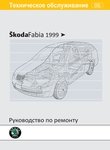
The Skoda Fabia models
covered
by this manual were manufactured between March 2000 and December 2005.
Models included in this Manual are available with 1.2 litre 3-cylinder
SOHC 6-valve, 1.2 litre 3-cylinder DOHC 12-valve, 1.4 litre 4-cylinder
8-valve, and 1.4 litre 4-cylinder 16-valve petrol engines. The diesel
engines available are 1.4 litre 3-cylinder (6-valve) and 1.9 litre
4-cylinder (8-valve). 1.0 litre OHV and 2.0 litre 16-valve petrol
engines are not covered in this Manual. 1.9 litre diesel engines are
available in normally-aspirated and turbocharged versions. All petrol
engines use multi-point fuel injection, and are fitted with a wide range
of emission control systems.
All the engines are of a well-proven design and, provided regular
maintenance is carried out, are unlikely to give trouble. Skoda Fabia
models are available in 5-door Hatchback, 4-door Saloon and 5-door
Estate body styles. Fully-independent front suspension is fitted, with
the components attached to a subframe assembly; the rear suspension is
semiindependent, with a torsion beam and trailing arms. A five-speed
manual gearbox is fitted, with a four-speed automatic gearbox available
as an option for 1.4 litre 16-valve petrol engine models. Note: At the
time of writing, no information was available for the 6-speed gearbox
(code OAB) fitted to vRS models. A wide range of standard and optional
equipment is available within the model range to suit most tastes,
including anti-lock braking, traction control and air conditioning.
For the home mechanic, Skoda Fabia models are straightforward vehicles
to maintain, and most of the items requiring frequent attention are
easily accessible. Your Skoda Fabia Manual The aim of this manual is to
help you get the best value from your vehicle. It can do so in several
ways. It can help you decide what work must be done (even should you
choose to get it done by a garage). It will also provide information on
routine maintenance and servicing, and give a logical course of action
and diagnosis when random faults occur. However, it is hoped that you
will use the manual by tackling the work yourself. On simpler jobs it
may even be quicker than booking the car into a garage and going there
twice, to leave and collect it. Perhaps most important, a lot of money
can be saved by avoiding the costs a garage must charge to cover its
labour and overheads. The manual has drawings and descriptions to show
the function of the various components so that their layout can be
understood. Tasks are described and photographed in a clear step-by-step
sequence. References to the 'left' and 'right' of the vehicle are in the
sense of a person in the driver's seat facing forward.
Acknowledgements Thanks are due to Draper Tools Limited, who provided
some of the workshop tools, and to all those people at Sparkford who
helped in the production of this manual. This manual is not a direct
reproduction of the vehicle manufacturer's data, and its publication
should not be taken as implying any technical approval by the vehicle
manufacturers or importers. We take great pride in the accuracy of
information given in this manual, but vehicle manufacturers make
alterations and design changes during the production run of a particular
vehicle of which they do not inform us. No liability can be accepted by
the authors or publishers for loss, damage or injury caused by any
errors in, or omissions from, the information given.